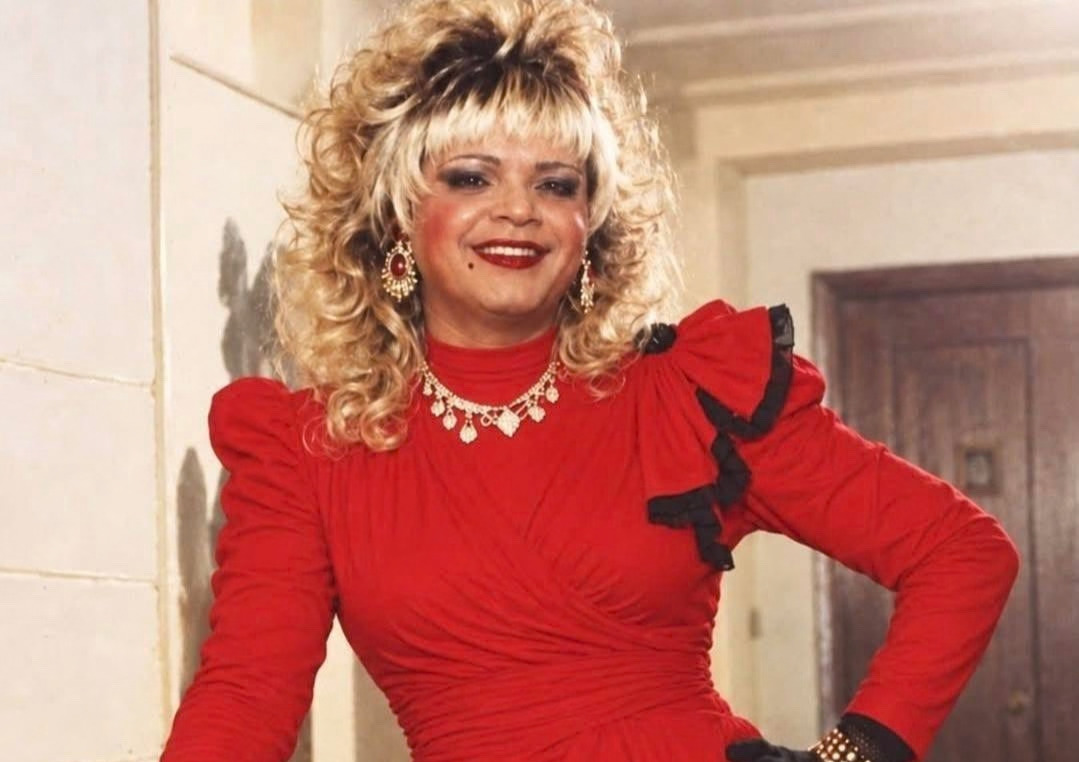
We don’t seem to hate men in dresses. We only allow it when there’s a punchline though!
We’ve seen the scene a thousand times.
The wig goes on. The dress goes on. probably a little too much makeup, a voice three octaves higher, an exaggerated walk and, inevitably, a room full of people losing their minds laughing.
We grew up on that shit.
A famous male comedian plays a woman and suddenly, it’s funny, iconic and gets quoted for years.
Mohamed Henedy has made a whole career out of making us laugh, and his roles in ‘Ya Ana Ya Khalty’ and ‘Ga2ana Al Bayan Al Taly’ are part of that familiar comedic scene. In the former, he disguises himself as a fortune-teller auntie to get closer to the woman he loves. In the latter, he goes undercover as a woman while investigating a story. There is a plot to get through, a disguise to sell, and most importantly a joke waiting to be cracked.
We’ve all laughed at scenes like these. but what exactly were we laughing at?
Because this is where things get interesting…
A man can put on a dress, a wig and a full face of makeup, make femininity the entire joke, and that’s socially acceptable as it will be labelled “comedy”.
But when someone walks onto a stage as a drag performer on purpose, without a fictional disguise to explain it, the conversation suddenly shifts to morality, tradition, public decency and what kind of performance should be allowed to exist.
Apparently, the dress isn’t necessarily the problem.
It’s who is wearing it, why they’re wearing it, and whether they have an excuse.
& this poses a question, why is it okay to exploit aspects of queerness and drag for a laugh yet on the contrary it’s not okay to give them space to be respectfully represented by actual queer folks?
THE COMEDY ALIBI
In ‘Ya Ana Ya Khalty’, the disguise is part of the mission. In ‘Ga2ana Al Bayan Al Taly’, it’s an undercover trick. In the stage play ‘Hazemni Ya’, women’s clothing is used within a comic plot. The costume isn’t necessarily the whole point. It’s a tool to move the story, create confusion, set up a reveal or, obviously, get a laugh.
Other films kept recycling the same formula.
‘Raghda Metawahesha’ brings the idea into a more contemporary Egyptian comedy, with Ramz Galal taking on a female role in an advertising-related storyline. ‘Karkar’, another Mohamed Saad comedy, belongs in the conversation too, not as proof that every role is drag, but as part of the wider screen tradition of using gendered costumes and exaggerated character work for laughs.

These performances sit at different points between disguise, character acting and gender performance. And that distinction matters. The audience knows the character is “really” a cis man. The disguise is temporary. The plot will eventually return everything to the familiar order.
The wig comes off.
The dress comes off.
The “masculinity” comes back.
Comedy becomes the alibi.
THE WIG IS DOING TOO MUCH
So here’s the formula.
The wig.
The voice.
The walk.
The stereotype.
Suddenly she’s vain, hysterical, manipulative, needy, dramatic, obsessed with men or sexually available. Basically a whole caricature.
So, the joke wasn’t simply that a man was wearing a dress. The joke was often that a man was being feminine.
And this is where we need to take a moment and think. Cause if femininity is inherently funny when performed by a man, what exactly are we being taught to find ridiculous?
OKAY, BUT WHO’S THE PUNCHLINE?
Now the part that gets less attention: the women.
A man playing a woman isn’t automatically misogynistic. Cinema can absolutely use gender disguise to expose hypocrisy, poke fun at macho posturing, or show how arbitrary certain social rules are.
A great example is Sahbety (2022), which gives us a very different use of cross-dressing. When the male character dresses as a woman, the costume isn’t there to make femininity itself look hideous or to milk laughs out of a man “becoming” a woman. It serves a purpose within the story. The disguise helps move the narrative forward, rather than turning the very idea of femininity into the punchline. And that distinction matters. The joke isn’t simply “look, a man in a dress!” The clothing has a function beyond humiliation, exaggeration or mockery. In that sense, ‘Sahbety’ shows that cross-dressing on screen doesn’t have to rely on making women or femininity the butt of the joke. A man can wear the dress, the story can actually go somewhere with it.

Cause at one point the joke stops being “look, a man is pretending to be a woman.”
It actually turns into “Look how ridiculous women are.”.
And that’s where the male gaze enters the room.
Whose perspective is shaping the joke?
Are we laughing at the absurdity of a sexist expectation, or are we being invited to laugh at women themselves?
Because when femininity is exaggerated into something ridiculous, the joke can end up reinforcing the very stereotypes it might pretend to poke fun at. It also gives the writers room trivialize serious topics like sexual assault which we see in movies like ‘raghda motawahesha’.
And here’s the fucked up part, the man gets to borrow those stereotypes for five minutes, get the biggest laugh in the room, take the costume off, and leave. Women don’t get to take femininity off.
And that’s not a reason to erase these performances from the cultural record. It’s a reason to look at them from a different angle.
THE DRESS COMES OFF
And this is where drag changes the conversation.
Because drag and cross-dressing aren’t necessarily two completely separate worlds. Drag has never had one single definition, and not every person who performs exaggerated femininity is a drag queen. A stage performer, an actor playing a woman, a celebrity impersonator, a comedian in a wig, a queer artist building an entire persona… All of those can exist somewhere along the very broad spectrum of gender performance. Even the origins of the word drag are tied, at least in one widely cited explanation, to theatrical slang for men performing female roles onstage, with the costumes literally “dragging” along the floor.
So yes: some of the men we’ve been talking about could technically be doing a form of drag.
And honestly? Even a misogynist can do drag.
Because the dress itself doesn’t magically make the performance progressive, queer, feminist or subversive. A man can put on a wig and a dress and still be deeply committed to every sexist idea about women that he is exaggerating.
The intention behind the exaggeration is what changes the conversation.
DRAG DIDN’T ARRIVE YESTERDAY
And no, drag in the Arab world is not some imported trend that appeared the minute people discovered RuPaul’s Drag Race.
Arab performance culture already has its own history of female impersonation and theatrical gender performance.
We got the Lebanese comedian Bassem Feghali, known for his impersonations of Arab female singers. Reporting on Beirut’s drag scene has described performers drawing inspiration from Feghali as well as from international drag culture, while creating performances rooted in Arabic music, humor and local references.
So the idea that gender performance is somehow completely foreign to Arab culture doesn’t quite hold up.
Today, Beirut remains one of the region’s most visible spaces for contemporary drag performance. Artists such as Diva Beirut have spoken about building an Arabic style of drag rather than simply copying a Western template.
The performances can include lip-sync, impersonation, oriental dance, comedy and the creation of a distinct stage persona.
That visibility exists alongside very real challenges. Performers have spoken about stigma, fear and the need to protect their safety.
Which brings us back to the old comedy scenes.
Because we’ve already seen Arab men transform themselves into women for the camera.
We’ve already laughed with them.
We’ve watched the wig become iconic.
We’ve watched the dress become part of a beloved character.
We’ve accepted the voice, the makeup, the exaggerated femininity and the entire performance as long as the movie gave us one very important piece of information:
Don’t worry. It’s just a joke.
SO WHAT’S ACTUALLY MAKING PEOPLE UNCOMFORTABLE?
Maybe the issue isn’t that Arab audiences have never seen men perform femininity.
Clearly, we have.
Maybe the issue is what happens when the performance doesn’t come with an alibi.
When there is no undercover mission.
No fictional auntie.
No punchline that restores the status quo.
No promise that the dress is coming off at the end.
Because contemporary drag asks us to look at the performance without the comfort of a fictional excuse.
And it asks us to take the artist seriously. Not because drag needs to be treated as beyond criticism, but because it is art, and art deserves to be discussed as more than a scandal or a punchline.
We also shouldn’t pretend that every Arab audience has one opinion, or that everyone who loved Henedy’s performances would automatically reject a drag show. The point isn’t to flatten millions of people into one reaction.
The point is to notice the contradiction.
We’ve spent decades accepting men performing femininity when femininity is there to entertain us.
So what changes when that same femininity belongs to someone who is choosing it for themself?
The comedian gets applauded. The drag queen gets cancelled. And that’s a double standard worth talking about.
We’ve never really had a problem with the dress.
We’ve had a problem with who gets to wear it unapologetically.
AKHBAR HABIBI / أخبار حبيبي
Culture, context and a point of view. Our archive includes stories carried forward from Habibi Plz with their original publication dates. Read our editorial standards.